
About Me
I'm Cliff, and I've spent my life learning what it actually takes for a group of people to trust each other.
And I've finally found the science that explains why.
The Work
I've spent two decades as a trial communications consultant to some of America's leading plaintiffs' attorneys, helping craft the narratives that persuaded juries to award billions in verdicts.
The first case that defined my career was the nation's first Vioxx trial. I helped trial lawyer Mark Lanier build the opening statement. The jury awarded $253 million. Fortune magazine called the experience "frighteningly powerful." That description stuck.
Since then, I've worked on 150+ cases: antitrust, personal injury, pharmaceutical liability, patent, and more. My most recent case was a $5 billion antitrust verdict with Bill Carmody of Susman Godfrey.
What I've always done in those rooms is not just make better presentations. I read the group field. I find the narrative arc. I create the conditions for a room to turn.
It took me 20 years to understand exactly what I was doing, and why it worked.
The discovery
I started as a writer and journalist. In 2003 I published a series of articles arguing that the real problem with presentations wasn't the software. It was that communicators were talking at audiences instead of thinking with them. The board of directors of GE read them and called me. That became my first client.
In 2005 Microsoft Press published Beyond Bullet Points, my synthesis of cinematic storytelling and strategic communication. It sold 125,000 copies, was published in four editions, and was translated into a dozen languages. Amazon named it a Best Book of the Year.
After that first Vioxx trial, the next two decades I lived inside the most complex, high-pressure group dynamics imaginable: trial teams, mediations, jury rooms. I watched some groups perform brilliantly under impossible pressure and others collapse under far less. I kept asking the same question: what's actually happening between people when things go right?
The answer turned out to be one of the most well-documented phenomena in neuroscience, and one of the least talked about in everyday life.
What I found
The human nervous system didn't evolve to regulate alone. It evolved in small groups of five to seven people, breathing together, moving together, sharing the load of survival across multiple bodies. Modern neuroscience calls this co-regulation. I call it Group Sync.
When a group of nervous systems synchronize through shared breathing, eye contact, and rhythmic interaction, the stress hormones drop, perception opens, cognition clears, and something remarkable becomes possible: collective intelligence. The group becomes more than the sum of its parts.
What I had been doing intuitively with trial lawyers for decades was creating the optimal biological conditions for a jury to decide, which is Group Sync. I had been doing it before I had the science to explain it.
Now I have the science. And I've built a practice anyone can use.
Group Sync
Group Sync is a 20-minute structured practice: a circle, a card deck, a ball, and three shared breaths; that synchronizes nervous systems and creates the conditions for a group to perform at its best.
It works for C-suite leadership teams navigating organizational pressure. It works for trial teams preparing to turn a courtroom. And it works for anyone who has been carrying too much alone for too long and suspects there might be another way.
I work with corporations, law firms, and individuals who want what Group Sync offers: resilience, collective intelligence, and the biological conditions for trust to emerge naturally, rather than being forced.
Learn about Group SyncMy next book
My upcoming book Where's My Group? introduces Group Sync to a general audience. It makes the case that self-help has a structural blind spot: it works on the individual nervous system in isolation, when the human nervous system was never designed to heal, regulate, or thrive alone.
The missing piece isn't more self-work. It's the group.
Where's My Group? is coming soon.
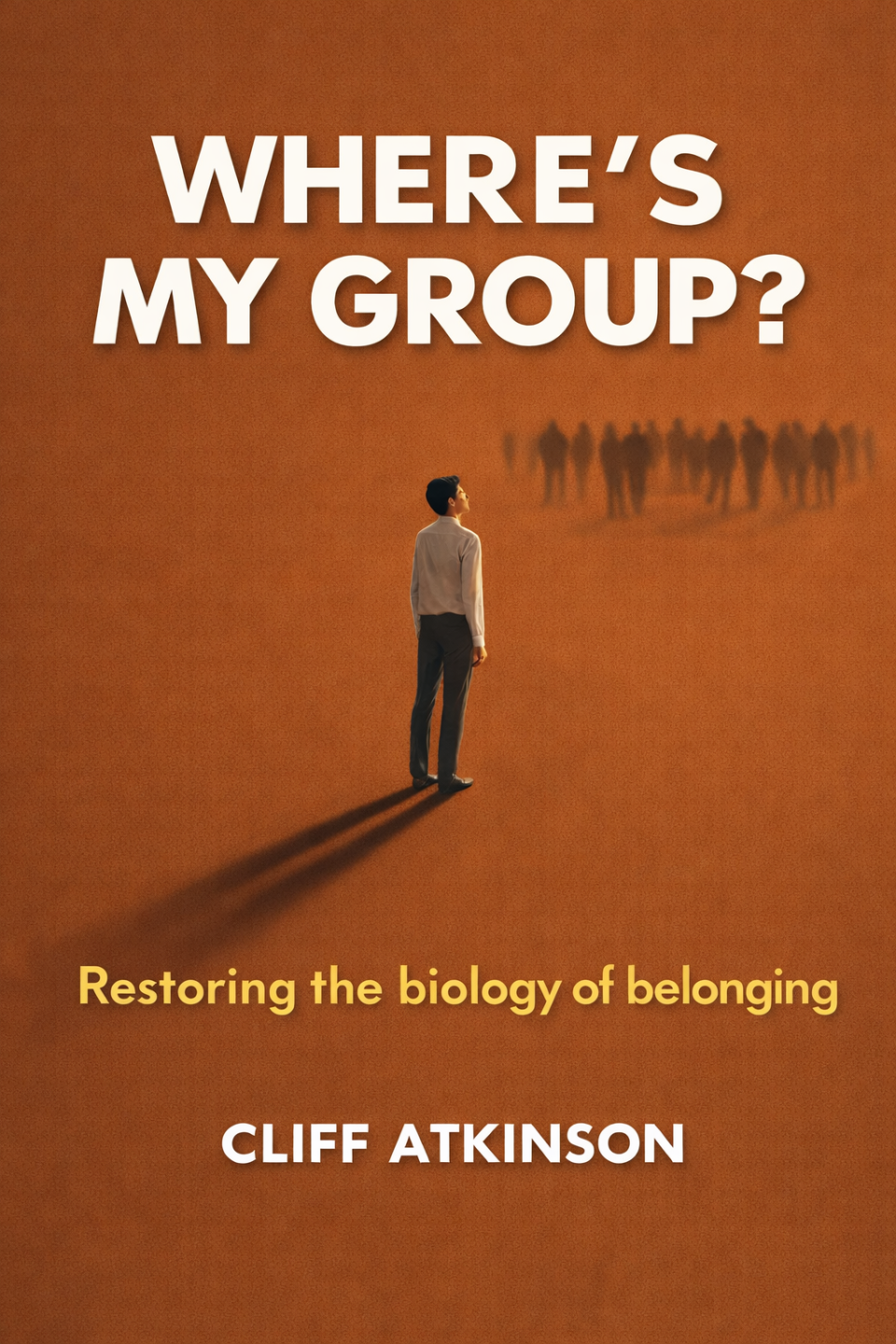
Join the Where's My Group? Newsletter to get updates on the book.
A little more
I hold a B.A. in English and Journalism from Baylor University and an MBA from Richmond, The American International University in London. I served as a Captain in the U.S. Air Force. I've lived in 32 places over 61 years, including Germany, Spain, California, New York, and many places in between; and have spent the last stretch as a nomad without a fixed address, following the work and the science wherever they lead.
I read everything I can find on co-regulation, evolutionary developmental biology, attachment theory, group dynamics, predictive processing, and the neuroscience of social safety. The researchers who have most shaped my thinking include Allan Schore, James Coan, Beatrice Beebe, Sarah Hrdy, Darcia Narvaez, and Ray Castellino.
When I'm not working, I'm usually thinking about the same things I'm working on, which is either a character flaw or a sign that I've found the right work. Probably both.
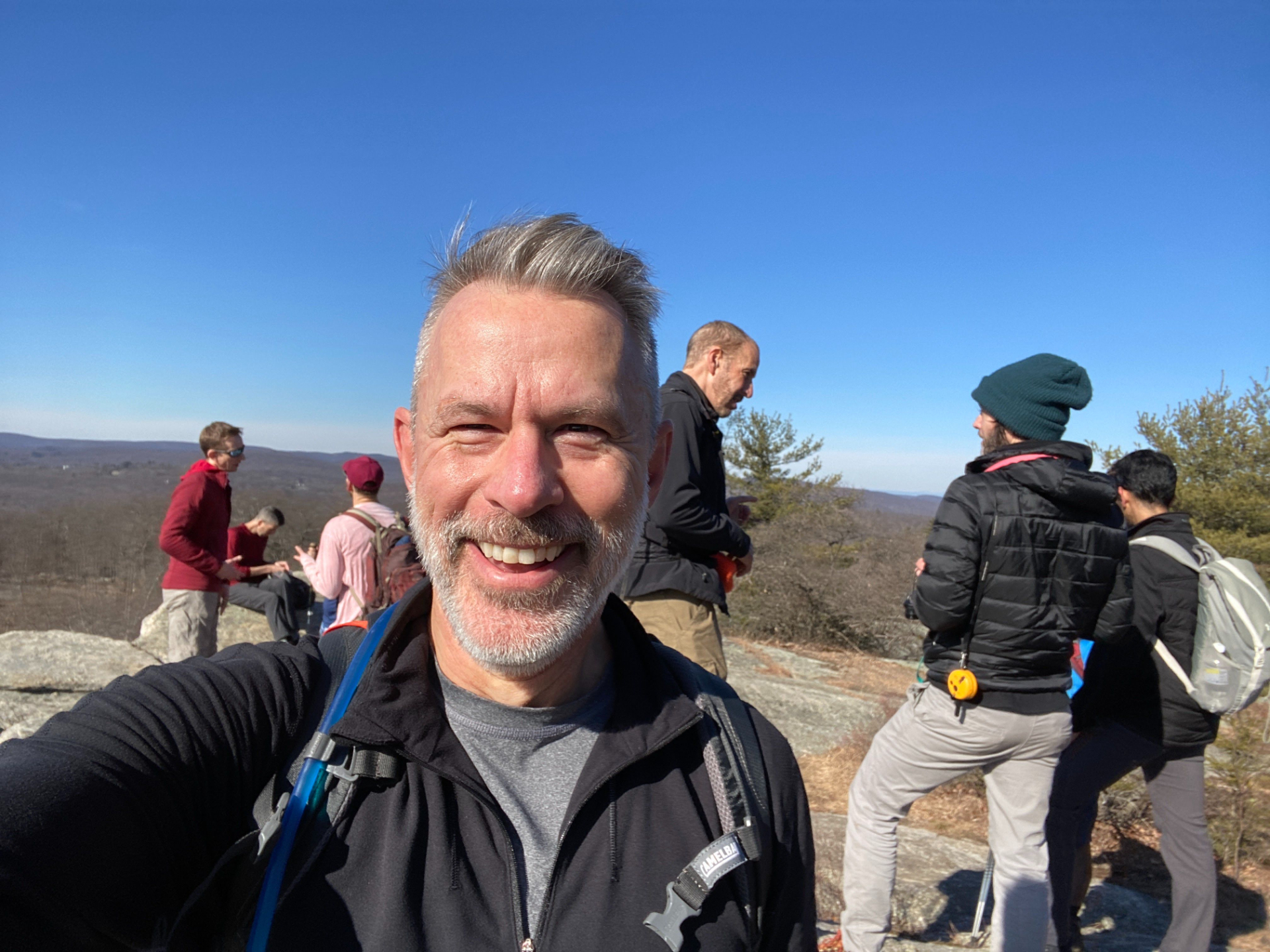
You might find me enjoying a hot coffee at sunrise, paddle boarding on a calm mountain lake in Quebec with my husband Louis, eating fish tacos with friends in Texas, or writing beneath a palapa on a beach in Oaxaca.
Let's talk
If you're preparing for trial, building a leadership team, or curious about The Group Sync Project — I'd love to have a conversation.
Contact Cliff