
Group Sync in the Living Room
You've done the work.
So why does it keep coming back?
Get the Group Gap Map — FreeYou know this feeling.
Shoulders tight before your feet hit the floor. Thoughts spinning at 2 a.m. around the same things they were spinning around last week. A low-level tension that never fully releases, even after a good night's sleep, a hard workout, a meditation session that actually worked.
You're not imagining it. And you're not failing.
Your nervous system is sending you a signal. It's just not a signal that any individual solution was designed to answer.
You've tried everything that was supposed to work.
Therapy. Coaching. Meditation. Journaling. Habits. Breathwork. Ice baths. Apps. Books. Retreats. Some of them helped, genuinely. You're not the same person you were before you started doing the work.
But something never fully resolves. The anxiety returns. The old patterns reassert themselves under pressure. The deep settledness you've been working toward stays just out of reach.
You've probably wondered whether you're doing it wrong. Whether you need a different therapist, a better system, more consistency. Whether the problem is you.
It isn't. And here's why.
Your body isn't broken. It's doing a group job alone.
The human nervous system didn't evolve to regulate itself. It evolved in small groups: five to seven people whose nervous systems synchronized automatically, sharing the biological load of stress, threat assessment, and survival across multiple bodies.
When that group is present, the body shifts into what researchers call shared mode: cortisol drops, heart rate variability improves, thinking clears, and a deep felt sense of safety becomes available. Not because you've convinced yourself everything is fine, but because your biology has registered that you are genuinely held.
When that group is absent, the nervous system does the only thing it can: it braces. It tries to hold everything alone. And no matter how much individual work you do, no matter how good your therapist is, how consistent your meditation practice, or how healthy your habits; you're working against a biological reality that individual solutions were never designed to reach.
The tension that won't release isn't a sign that you need to try harder. It's a sign that your nervous system is missing its group.
The number that changes everything
A group of 6 people creates 15 lines of mutual support: 15 unique connections between every pair of members, each one capable of carrying some of the load your single nervous system has been holding alone:
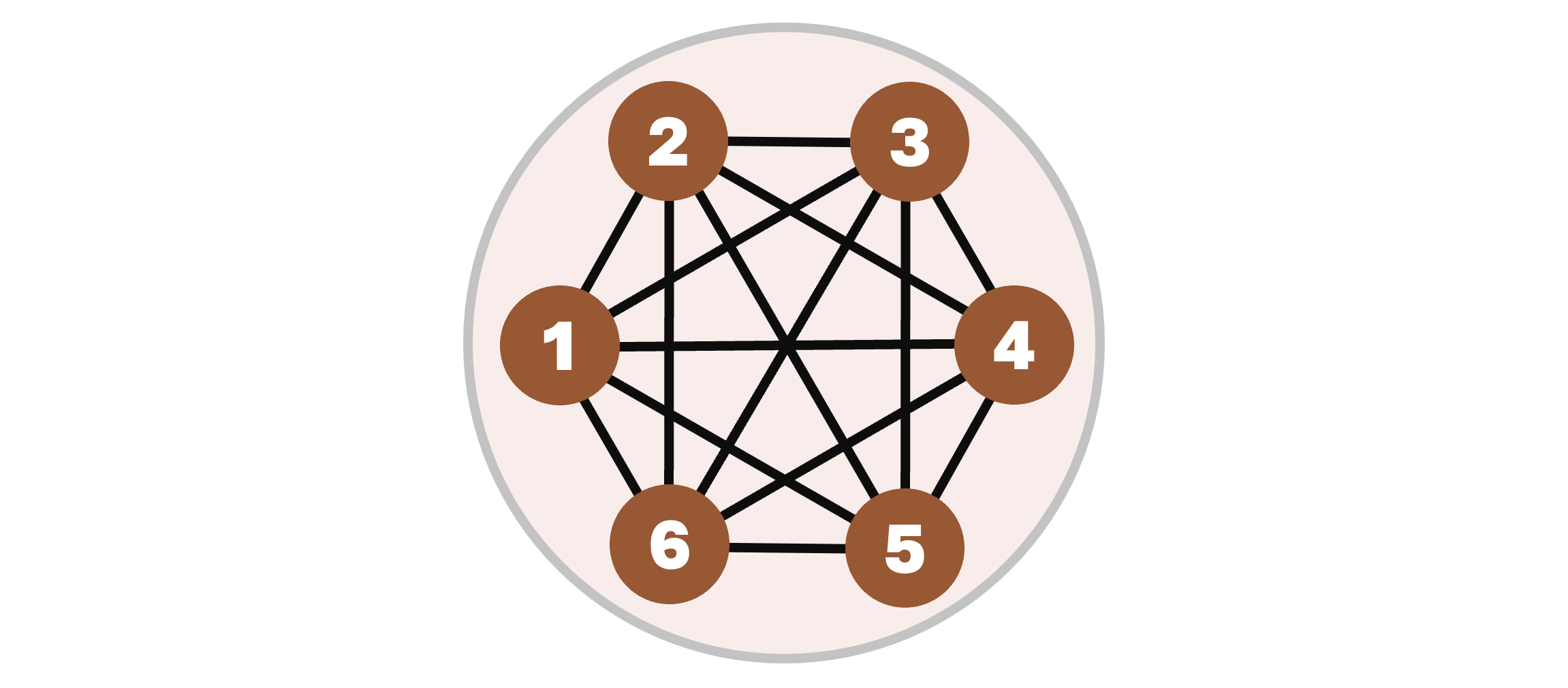
This living web of synchronized nervous systems has its own properties apart from its individual members. That's not a metaphor. That's the structural difference between what your nervous system has been trying to do and what it was actually designed for.
Your system can feel that difference. Within minutes of being in a circle with a synchronized group, something in the body shifts. The breath deepens. The shoulders drop. The thoughts slow. Not because you've done anything, but because the biology is finally getting what it's been signaling for.
What Group Sync actually is
Group Sync is a structured practice where 5-7 people meet for 25 minutes, sit in a circle, and use a simple card deck and ball to synchronize their nervous systems.
No therapy. No oversharing. No advice-giving. No facilitator required. Just a small group of people showing up consistently and giving their nervous systems what they were always designed to have.
Here's what a session looks like:
Breathe. The group opens with three shared breaths: the signal that tells every body in the room: we're in this together.
Ask. Someone reads a question from a card. A one-word check-in. A gratitude. Something you're carrying. A one-word check-out.
Toss. The ball gets tossed to decide who answers. No one has to choose or be chosen. You just catch the ball and share.
Breathe. The group closes with three more breaths. Twenty-five minutes. Done.
Twice a week. Eight weeks to establish the baseline. Sixteen sessions for your nervous system to accumulate enough evidence of safety to begin to shift.
What people report after Phase 1: relief. A calmer mind. A deeper breath. The beginning of something they don't quite have words for yet, but that feels, for the first time in a long time, like enough.
Where Group Sync takes you
Phase 1: The Check-Ins. 8 weeks, 25 minutes twice a week. Establish baseline synchronization. The load you've been carrying alone starts to be held by the group. What emerges: relief, calmer mind, deeper breath, the beginning of trust.
Phase 2: The Deep Dives. 6 months, weekly 60-minute sessions. With trust established, the nervous system begins to release what it's been holding; not through analysis, but through the felt safety of being truly held. Old patterns start to shift. The body begins to update what it learned before it had words. What emerges: spontaneous release, old patterns softening, something that feels like coming home.
Phase 3: The Projects. Ongoing. The synced group turns its energy outward. The capacities that emerge, such as trust, flow, collective intelligence, get applied to shared projects, creative collaboration, and contribution to something larger than any one person. What emerges: group flow, collective intelligence, the sense that the group has become more than the sum of its parts.
Common questions
Is this therapy?
Do I need to find my own group?
Can we meet by video?
What if I've tried group therapy and it didn't work?
Do I need to share personal things?
Three ways to start
1. Draw your Group Gap Map — Free
A 5-minute exercise that shows you how to map the gap between the support your nervous system has now and what it's designed for. The clearest way to understand what Group Sync addresses.
Learn more2. Join Our Next Online Workshop
The live 90-minute online workshop is the fastest way to understand Group Sync at depth and learn what you need to experience it for yourself.
Learn more3. Get the Group Sync Launch Kit
Everything you need to form your group right now: invitation scripts, agreement template, first-session walkthrough, card deck, and more.
Learn moreYou were never supposed to figure this out alone.
The fact that you've been trying to figure this out with sincerity, with discipline, and with real courage says something important about who you are.
But the nervous system doesn't update through effort. It updates through experience. Specifically, through the repeated experience of being genuinely held by a group of people whose nervous systems are synchronized with yours.
That experience is simpler than you might think. It takes 25 minutes. It requires five other people. And it starts with three shared breaths.
